
Flan Parisien
A French Classic

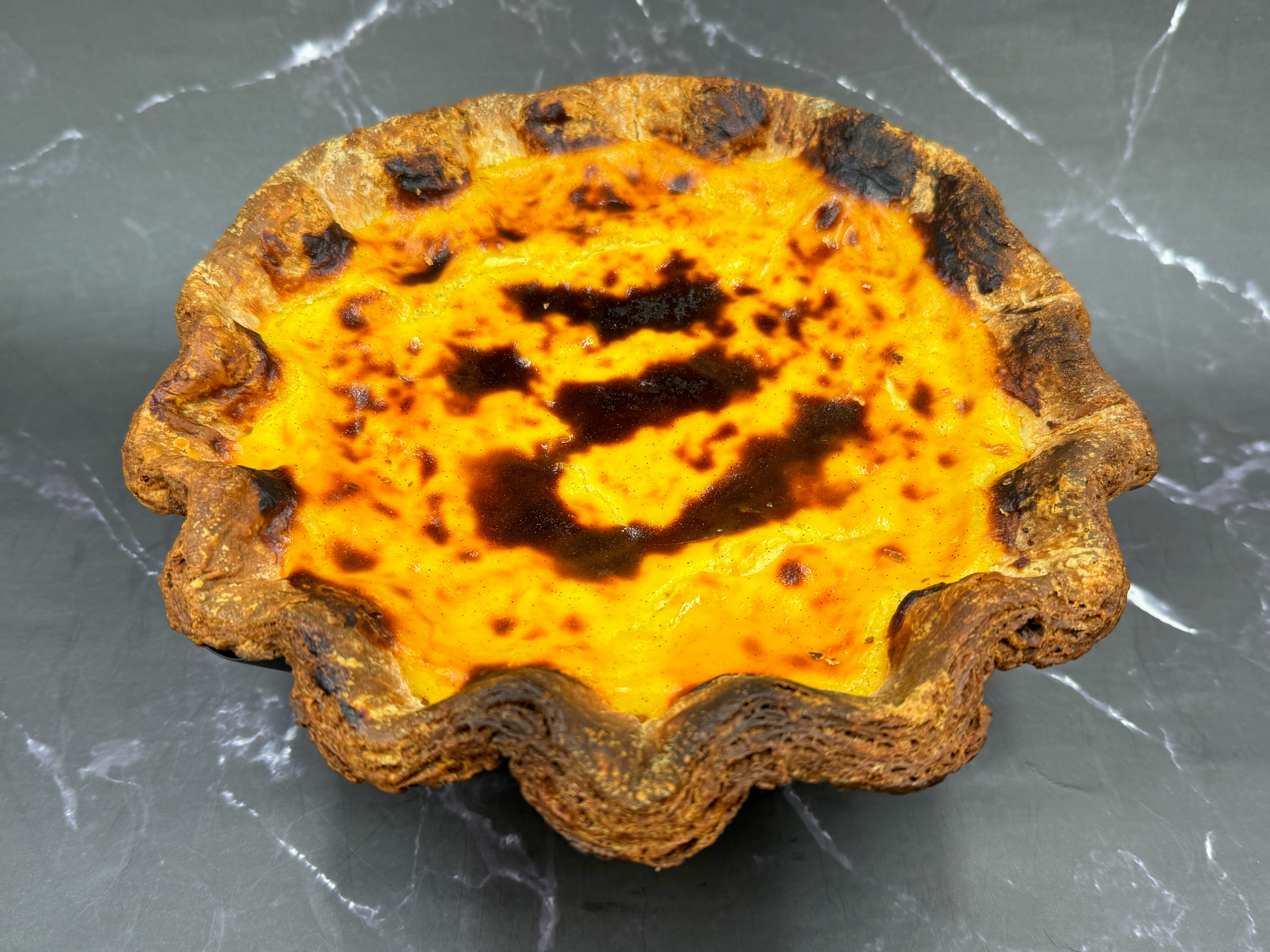
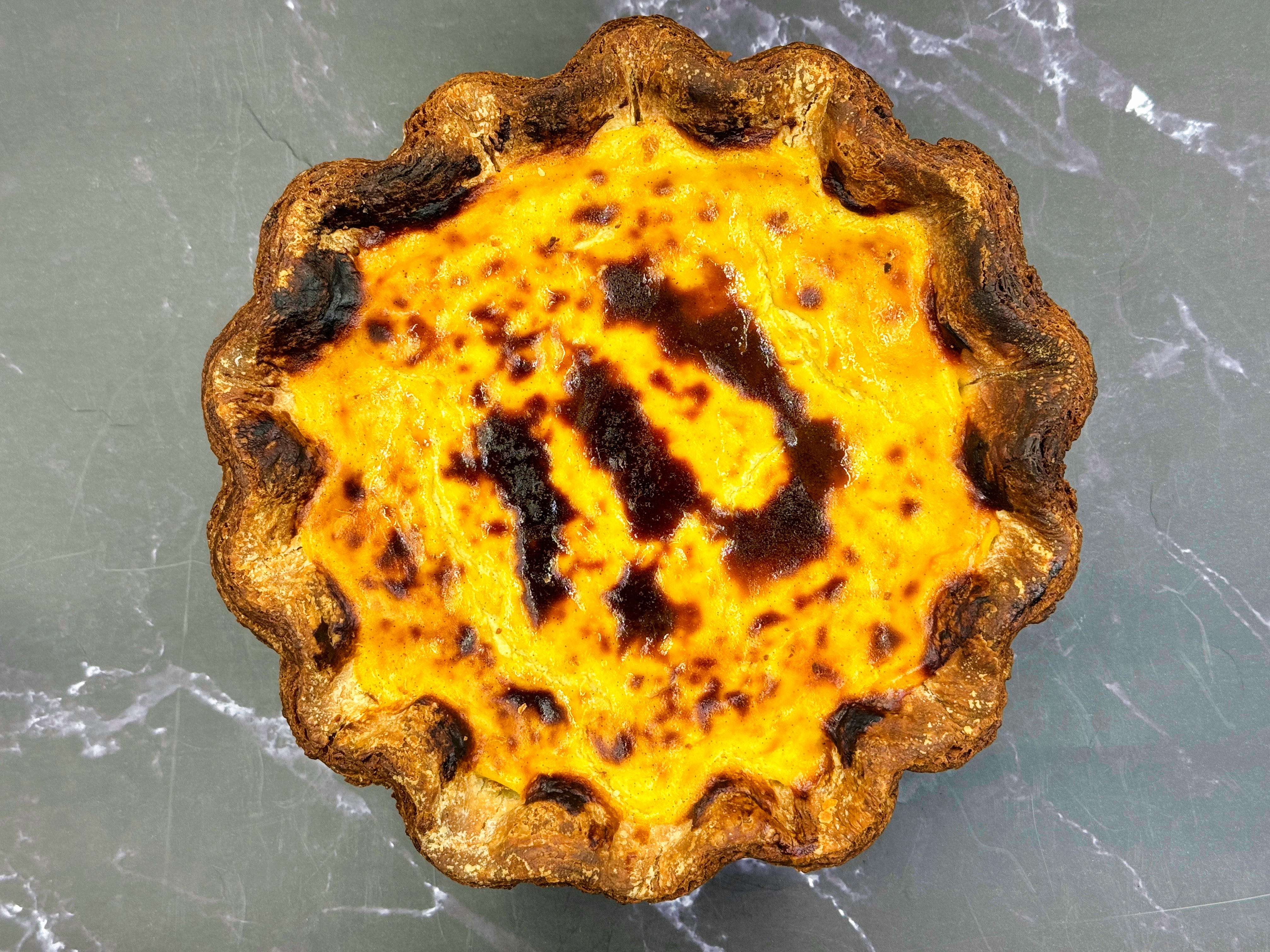
Flan Parisien, also known as Parisian Flan or Flan Pâtissier is a quintessentially French dessert combining the vanilla custard's richness and smoothness with a deliciously flaky crust. If you love custardy desserts then this recipe is for you.
If you ever had the pleasure of going to France and stepping into any bakery, you would have most likely seen thick wedges of Flan Parisien in their pastry cases. Although the word flan might evoke images of a wobbly French Crème Caramel, Japanese Purin or Filipino Leche Flan, Flan Parisien is basically a baked custard pie.
Components
Flan Parisien has three main components – a flaky crust, a rich and dense custard and a burnished custard surface.
Flaky Crust: You can use any pie/tart crust you want ie paté sucrée, rough puff pastry, frozen puff pastry or paté brisée. However, this recipe will use laminated brioche dough (Brioche Feuilletée).
Custard: I used a basic vanilla crème pâtissière (vanilla custard cream) because it bakes well and doesn’t curdle. This recipe uses whole vanilla beans but you could substitute it for vanilla extract or vanilla bean paste.
Burnished Custard Surface: Before baking, I brushed the custard with beaten egg yolk for a beautifully burnt surface.
Lamination
In the world of laminated doughs, there are two basic types – yeasted and unyeasted.
Lamination in unyeasted doughs can be seen in their simplest forms in bakes like flaky pie dough, pasteis de nata shells and Southern-style American biscuits.
Lamination in yeasted doughs on the other hand can be seen in the obvious confectioneries like croissants, kouign amann and palmiers. However, for the non-obvious, bakes like cinnamon rolls, babkas and sticky buns are also technically laminated by spreading a thin layer of filling and then rolling them up, creating a few layers of delicious lamination.
Brioche Feuilletée
*Making the pastry is honestly the most difficult and time-consuming part of this recipe. It is very technical and involved. If you don’t wish to make it or don’t have the time for it, I totally get it. Just cut and blind-bake any other type of pastry that you would like then follow the rest of the recipe as directed.*
Brioche Feuilletée is a French pastry that combines both brioche and puff pastry. It is flaky and buttery, similar to puff pastry, yet it retains the richness and sweetness of brioche. It is made by rolling and laminating layers of butter between dough. If you’ve made or seen how croissants are made, the technique is essentially the same.
You first start by making a dough (détrempe) and a butter block (tourage). Then, you roll out the dough into a rectangle two times the width of the butter block. Next, you put the butter block onto the dough and cover it with the excess dough. Next, you roll it out into a rectangle and fold it over itself into thirds, just like folding a letter. This is called a simple turn. Repeat the simple turn two more times and your brioche feuilletée is ready to be rolled out again for the last time and used.
Custard Filling
In this recipe, we will be making a classic vanilla crème pâtissière. Crème pâtissière is basically a delicious, rich, creamy custard, thickened with starch and eggs.
The difference between custard and crème pâtissière is that crème pâtissière is a thicker version of custard, achieved by adding thickeners like cornstarch. At their core, they are made simply with milk, sugar and eggs.
To make the vanilla crème pâtissière, you start by pouring the milk into a saucepan and adding your halved and scraped vanilla bean (or vanilla paste/ extract), bringing this mixture to a boil. While the milk mixture is heating up, whisk the eggs, egg yolks, sugar and cornstarch together until well combined and no lumps. Next, temper the egg yolks by slowly adding the hot milk mixture to the egg mixture while whisking. After that, transfer the custard mixture back into the saucepan and bring it back up to heat while constantly whisking until it becomes thickened. Lastly, bring the custard off the heat and whisk in the butter until well combined and glossy. Let the custard cool to room temperature.
Special Equipment
20cm Fluted Brioche Pan
Stand Mixer
Brioche Feuilletée
120g Milk
4g Instant Yeast
330g Pastry Flour
60g Whole Eggs
6g Fine Salt
20g Sugar
30g Unsalted Butter, softened
180g Unsalted Butter, softened (for the butter block)
Crème Pâtissière
800ml Milk
2 Vanilla Beans, split into halves and scrapped
160g Sugar
95g Egg Yolks
44g Whole Egg
55g Cornstarch
40g Unsalted Butter
Assembly
1 Egg Yolk, beaten
Baking Beads/rice/beans for blind baking
Brioche Feuilletée


1. Make the dough. In the bowl of a stand mixer, add the flour, yeast, salt and sugar and mix well to combine. Then add in the milk and eggs. Mix on for about 1 minute on low speed with a dough hook until a shaggy dough is formed. Add the softened butter then continue mixing on medium speed until a smooth ball is formed and the dough pulls away from the sides of the bowl – about 3 to 4 minutes. Cover and let the proof at room temperature for 1 hour. Form the dough into a rough rectangle shape and wrap it in cling wrap. Transfer the dough to the fridge to firm up for 2 hours.
2. Make the butter block. Cut the butter into chunks and place them between two sheets of parchment paper. Fold and close the edges of the parchment to make a 20cm square. Using a rolling pin, gently tap and roll the butter between the parchment paper to spread it out and make an even butter block. Transfer the butter block to the fridge to harden – about 1 hour.


3. Lamination. Remove the dough and butter block from the fridge. Then let the dough come back to temperature so that it is softer. Dust a clean work surface and dough with flour then roll it out into a 20cm x 40cm rectangle. Dust the dough and the work surface as needed.
By this point, the dough and butter block should have the same consistency. You should be able to bend the butter block slightly without it breaking. If it is too soft, put the dough and butter block back in the fridge for 15 minutes.


Next, place the butter block in the centre of the dough then fold the two sides of the dough over it to close. Using a floured rolling pin, gently tap the dough to encase the butter and dough together.


Do a simple turn. Dust the work surface and dough with flour and gently tap and roll the dough and butter block into a 20cm x 40cm. Next, fold the dough into thirds just like folding a letter. Gently tap the dough with a rolling pin to make sure that the layers adhere to each other. Cover with cling wrap and transfer the dough into the fridge to firm up and rest – 45 minutes. Repeat this step 2 more times for a total of 3 simple turns. Before rolling the dough and laminating it, make sure that the dough and butter are of the same consistency by letting it come up to temperature for about 15 to 20 minutes. Transfer the laminated dough back into the fridge until ready to use.
Crème Pâtissière
1. In a large saucepan, add the milk, vanilla bean pods and scrapped seeds. Bring to a boil then remove from heat and cover to steep for 10 minutes.
2. In a large bowl, whisk together the whole eggs, egg yolks, sugar and cornstarch until well combined.
3. While whisking, slowly stream in the milk mixture until all the egg and milk mixtures are combined. Transfer the custard mixture back into the saucepan and cook over low heat until it thickens, whisking constantly. Bring it off the heat and add it to the butter, whisking together until well combined.
4. Remove and discard the vanilla pods then pass the custard through a fine-mesh sieve into a large bowl. Cover the surface of the custard with cling film and let cool completely. Refrigerate for at least 4 hours to set.
Assembly
1. Grease the brioche mould with butter and set aside.


2. Remove the laminated dough from the fridge and let it come up to temperature. Roll the dough out into a 32cm x 32cm square on a work surface dusted with flour. Dust the work surface and dough with flour as needed.
3. Using a sharp knife, cut out a 30cm diameter circle. I used a wok lid as a guide.
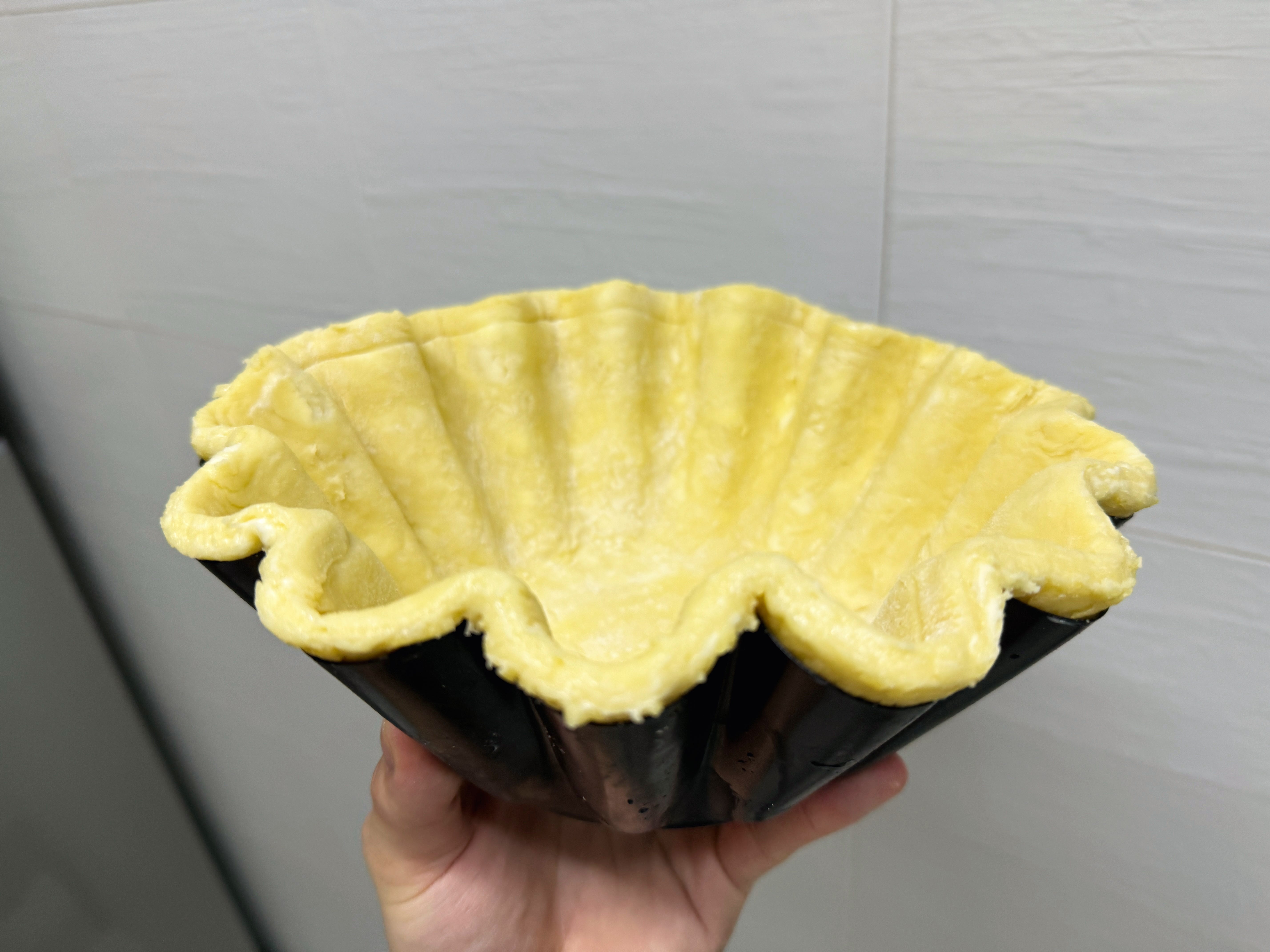
4. Gently press the dough into the fluted brioche pan to fill it. Freeze for 20 minutes until the dough is hardened. Preheat the oven to 220C.


5. Blind bake. Once frozen, crumple two large sheets of parchment paper then fit them into the frozen crust in an X arrangement. Fill with baking beads/rice/beans almost to the top, making sure that there are no gaps.
Bake for 25 minutes. Gently remove the parchment paper and baking beads/rice/beans. Bake for another 5 minutes or until the edges are golden brown. Let cool for 20 minutes.
6. Turn the oven down to 200C.


7. Using a whisk or a rubber spatula, loosen the custard. Next, fill the crust with the custard until about 1cm below the rim. Use an offset spatula to make an even surface.
8. Using a pastry brush, brush the egg yolk onto the surface of the custard.
9. Bake for 50 minutes then rotate the flan 180° and continue baking for another 15 minutes. The flan will puff up and be very wobbly towards the end of baking. It will set when cool. If the top of the flan is not brown and caramelized after baking, broil it for a few minutes.
10. Cool completely at room temperature then transfer the flan into the fridge to set overnight.
11. Remove the flan from the brioche pan and serve.
I would love to make many more of your recipes, Ryan, but I'm from the US and I'm unable to change your measurements so I can use them in my kitchen. Everything always looks so good that I could almost eat the paper I print them on. Thank you!❤️